




Museum
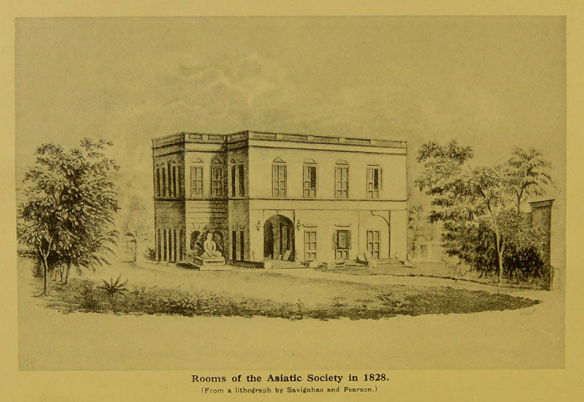
Museum
The Museum of the Asiatic Society is a repository of priceless & unique collections of manuscripts in different languages and scripts. A good number of catalogues were published by the Asiatic Society, both Descriptive and Tabular which are remarkable deeds in the study and research of manuscripts. The manuscript collection of the Society is varied and rich and covers most of the Indian languages and scripts. The total number of manuscripts now possessed by the Society in its Museum is 51022. The manuscripts are classified under different collections viz, Indian Museum Collection, Govt. Collection, Society Collection, New Society Collection, R.K. Dev Collection, Hodgson Collection, Islamic Collection, etc. Some of the oldest and rarest manuscripts possessed by the Society are Kubjikamatam of the 7th century A.D. written in Gupta Brahmi Script, Maitreyavyakarana of 10th century A.D, Kalachakravatara of Abhyankara Gupta dated to 1125 A.D, Samputatika of 1025 A.D. etc Apart from manuscripts, the Museum & Manuscript Section of the Asiatic Society also possesses old coins in various metals, inscriptions inscribed on Copper Plates and 78 very rich and valuable oil paintings, mostly portraits. Many of these were painted by Robert Home, Joshua Reynolds, Guido, Daniel etc. Some famous paintings that are housed in this Museum of Cleopatra, A Ghat at Benaras, Cupid asleep on the cloud, Warren Hastings, John Dewitt, Wellesley, Infant Christ, Ruins of Mahavalipuram, Woman Taken in Adultery etc. Sculptures and Metal Objects in the possession of the Asiatic Society are rich in respect of number and historical importance. Among these, are the stone sculpture of Brahma, made of Black Basalt, Period 12th Century A.D., Vishnu, made of Black Basalt Stone, 11th Century A.D., Brass statue of Dhurm Raja, (at present, this statue is in Bhutan) 1864, Ashokan Rock Edict in early Brahmi Script and of Prakrit language dated 250 B.C are some of the rare objects of this museum. A large number of survey maps drawn by British surveyors in the 18th & 19th centuries are also in the possession of the museum. Some remarkable maps reflect the change in the socio-political, economic & cultural scenario of India. In addition, a large number of old Correspondences of eminent personalities and Rare Books some of which date back to 1784, just after the Society was founded are also preserved here.
Manuscript
The wonderful library of Asiatic Society of Bengali, Sanskrit, Persian, Urdu, Chinese and Japanese manuscripts, compiling works of sacred texts, poetry, chronicles and autobiographies. The Society can use these few and frequently illuminated works to track the centuries of scholarship and literary creativity and book-making across the regions.
Paintings
In Kolkata the Asiatic Society holds some of the most important inscriptions, such as the Ashokan rock edicts and copper plate grants, which helped to understand the Indian rulers, religion and governance of the ancient times.
Sculptures
The Asiatic Society, Kolkata currently holds the paintings, that cut across the subjects of anthropology and zoology to botany, architecture and history, and are thus important visual records of early colonial India.
Coins
A large hoard of gold, silver and copper coins was saved by the Asiatic Society, some of which were subsequently donated by the Indian Museum in 1866, and the gold coins have now been sorted and readied awaiting a professional catalogue with the numismatic description of a learned expert. The specimens on display belong to different times and dynasties, which depicts the rich monetary and cultural heritage of India.
Inscriptions
The oldest inscription in the Society is the Bairat Edict of Ashoka, where James Prinsep first deciphered the Brahmi script in 1837, as well as the archives hold a great deal of valuable stone and copper-plate inscriptions, which record religious, historical, and administrative customs in different parts and through the centuries. These writings are invaluable sources of evidence about the early governance, religion, and cultural interaction in the subcontinent.
Rare Books
The library of the Society contains a wonderful collection of rare books and periodicals dating back between 15th and 19th century like the Firmicus volume published in 1499, Charles Wilkins translation of the Bhagavad Gita and the collection of works by William Jones, in addition to the early printed Bengali and Sanskrit literature. The books are a reflection of the development of scholarship, printing culture, and intellectual networks that contributed to the early modern knowledge on India.
Plates
Original drawings on stone were reproduced by means of lithographs first invented in 1796 and these gave a detailed artistic record of Indian life, pursuits, scenery and architecture the work of artists like Mrs. S.C. Belnos and Charles D.Oyly. The prints are incredibly rich historical records, portraying the daily life, city landscape, and cultural customs of the 19 th century India.